 how-to
Hiring a Contractor for Kitchen and Patio: A 2026 Guide
Table of Contents
- Hiring a General Contractor vs. Individual Subcontractors
- How to Check Contractor Licensing and Insurance
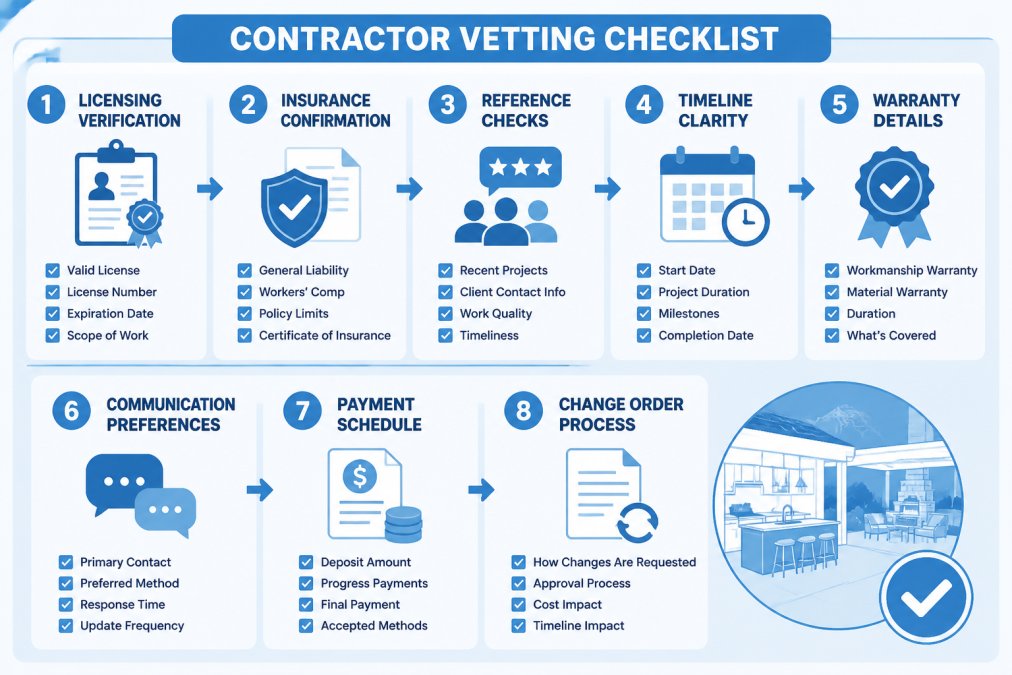
- Questions to Ask a General Contractor Before You Hire
- Understanding Project Scope, Estimates, and Contracts
- Managing Your Kitchen and Patio Project Timeline
- Permits, Building Codes, and Compliance
- Coordinating Indoor-Outdoor Integration and Contractor Accountability
- Frequently Asked Questions
Last Updated: August 31, 2026
The biggest decision in a kitchen and patio renovation isn't style, it's who builds it. The wrong contractor choice means months of delays, budget overruns, and costly quality issues. The right one delivers on time, within budget, and coordinates indoor and outdoor work seamlessly.
This guide walks you through finding, vetting, and hiring a contractor for kitchen and patio work. You'll learn the critical questions to ask, credentials to verify, and contract details that protect you.
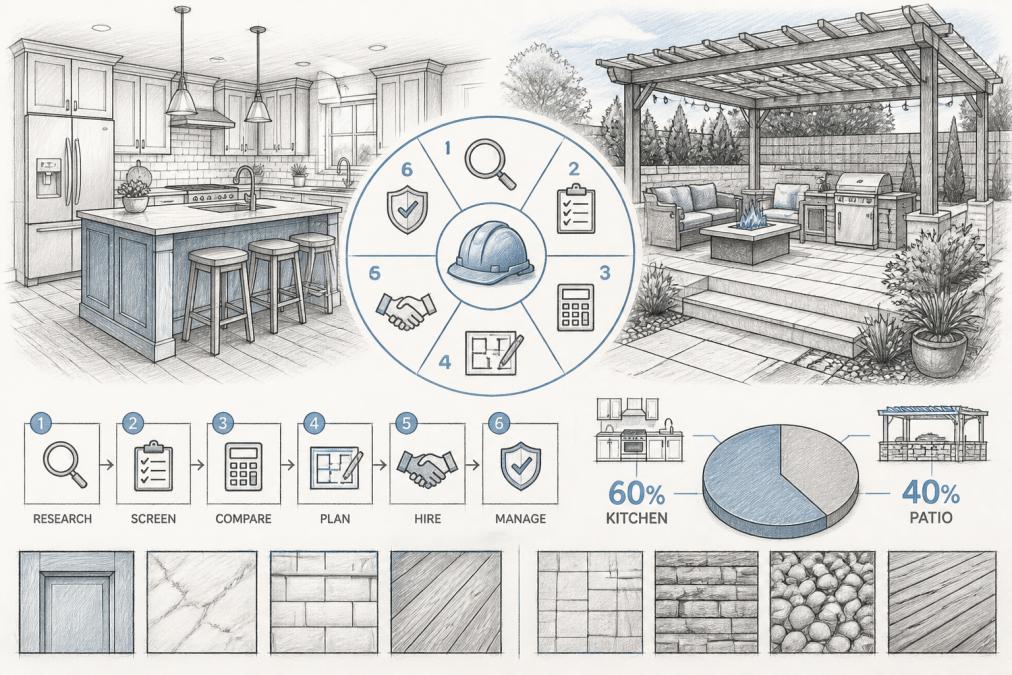
Hiring a General Contractor vs. Individual Subcontractors
Your first choice: hire one general contractor who manages everything, or hire individual subcontractors separately?
A general contractor coordinates all trades, pulls permits, schedules inspections, and manages the timeline. You have one point of contact and one person accountable if something goes wrong. The tradeoff: general contractors typically add 10-20% to project cost for management.
Individual subcontractors cost less upfront but you become the project manager. You schedule each trade, resolve conflicts, and chase down insurance certificates from multiple people. For integrated projects like kitchen and patio renovations, where indoor work (cabinetry, electrical, plumbing) must coordinate with outdoor work (patio foundation, utilities, drainage), this becomes a logistical nightmare.
A general contractor manages this complexity. They know the sequence, coordinate trades, and are accountable if one subcontractor's work delays another. That accountability is worth the coordination fee.
If you hire subcontractors individually, insist on a detailed project schedule showing every trade's timeline and dependencies before work starts.
How to Check Contractor Licensing and Insurance
Before you interview a contractor, verify three things: licensing, insurance, and background.
Licensing. Every state requires contractors to be licensed. Check your state's licensing board website (search "[your state] contractor licensing board"). Ask for the contractor's license number and verify it's current and in good standing. A valid license means they've passed an exam, met experience requirements, and carry bonding, a financial guarantee protecting you if they fail to complete work.
Do not accept "licensed in a neighboring state" or "registered but not personally licensed." Verify directly with the state board.
Insurance. A contractor must carry general liability insurance (covers damage or injury on site) and worker's compensation insurance (covers employee injuries). Ask for a Certificate of Insurance listing your address as an "additional insured." Call the insurance company's number on the certificate to verify it's active. Contractors sometimes provide outdated or lapsed certificates.
References. Ask for three recent references from kitchen and patio projects. Call them and ask: Did the project finish on time? Were there surprise costs? How did the contractor handle problems? Would you hire them again? A contractor who can't provide solid references is a red flag.
Questions to Ask a General Contractor Before You Hire
Write down these questions. A contractor who's evasive is telling you something important.
Experience and scope. "How many kitchen and patio projects have you completed in the last three years? Can you show me photos or take me to a recent one?" Kitchen and patio work requires specific skills, understanding how indoor utilities extend outdoors, managing transitions between indoor finishes and outdoor materials, coordinating multiple trades. A contractor with 20 years of framing experience but no kitchen or patio work isn't the right fit.
Timeline. "What's your realistic timeline from contract signing to final walkthrough?" Get a specific number of weeks, not a range. Ask what could delay it (permits, materials, weather, subcontractor availability) and what the contingency plan is.
Payment schedule. "What's your payment structure?" Typical options:
- A down payment, followed by draws based on work completed
Never pay more than 50% upfront. If a contractor insists on 75% or 100% upfront, they're either desperate for cash or planning to underfund the project.
Warranty. "What warranty do you provide on workmanship, and for how long?" Standard is one year on all work. Get this in writing. "Warranty" means the contractor fixes problems at no cost to you.
Change orders. "How do you handle scope changes?" Changes happen. A contractor should have a written process: you request the change, they provide a written quote for cost and timeline impact, you approve it in writing before work starts.
Communication. "How often will we communicate, and how?" Weekly progress meetings are standard. Ask if they use a project management tool (many contractors use apps showing daily photos, timelines, and change orders). Ask how quickly they respond to questions.
Subcontractors. "Who will be doing the plumbing, electrical, and hardscaping work?" Get names, not "trusted partners." If they won't name subs, you can't verify their licensing and insurance.
Understanding Project Scope, Estimates, and Contracts
A scope of work is the written description of exactly what the contractor will do. It's the most important document because it defines what's included, what's not, and what changes cost extra.
A good scope includes:
- Detailed description of every task (e.g., "remove existing kitchen cabinets and countertops," "install new electrical outlets in kitchen and extend service to patio")
- Materials specified by brand and model (e.g., "Shaker-style cabinetry, white oak, 3/4-inch plywood," not just "quality cabinets")
- Finishes and colors
- Timeline for each phase
- What's excluded
- Payment schedule, warranty terms, and change order process
Do not accept vague scopes like "kitchen renovation and patio installation." If the scope says "install new kitchen" and the contractor interprets that as cabinets and countertops only (no appliances, no backsplash), you'll pay extra for work you thought was included.
An estimate is the contractor's prediction of total cost based on the scope. If the scope changes, the estimate changes. A fixed-price contract means the contractor commits to a specific price regardless of what happens (unless you request a change order). Time and materials means you pay for labor and materials as work progresses; the final cost is unknown. For kitchen and patio projects, fixed-price is better because you know your budget upfront.
Compare estimates from at least two contractors. If one is significantly cheaper, ask why. A low estimate usually means they're cutting corners or underestimating the scope.
The contract should include the scope, estimate, payment schedule, timeline, warranty, and change order process. It should also specify:
- What happens if the contractor can't finish on time
- What happens if you request a change
- How disputes are resolved (arbitration is faster and cheaper than court)
- Whether the contractor obtains permits and schedules inspections
- Site cleanup and debris removal
Have an attorney review the contract if it's a large project. The cost of a quick legal review is worth the protection.
Managing Your Kitchen and Patio Project Timeline
A typical kitchen and patio project takes several weeks from contract signing to final walkthrough. Here's the realistic sequence:
Weeks 1-2: Pre-construction. Finalize design and scope. The contractor orders long-lead items (custom cabinetry, appliances, specialty materials) that take several weeks to arrive.
Weeks 2-4: Permits and inspections. The contractor applies for building permits (kitchen electrical, plumbing, structural; patio foundation and utility extensions). Permit approval takes a few weeks depending on your jurisdiction.
Weeks 4-6: Demolition and site prep. The contractor demolishes the existing kitchen, removes old patio if there is one, and excavates the new patio area. Your kitchen is unusable for a few weeks.
Weeks 6-10: Rough-in and framing. Plumbers and electricians run new lines (kitchen plumbing, electrical, gas; patio electrical and gas for outdoor kitchen or fire pit). Carpenters frame structural changes. The patio foundation is poured. Multiple inspections occur during this phase.
Weeks 10-14: Finishes. Drywall is installed and finished. Flooring is installed. Cabinetry and countertops are installed. Appliances are connected. Patio hardscape (pavers, stone, edging) is installed.
Weeks 14-16: Final touches and inspections. Backsplash is installed. Final electrical and plumbing connections are made. Patio utilities (outdoor kitchen connections, lighting, irrigation) are finalized. The contractor schedules a final inspection and you do a final walkthrough with a punch list.
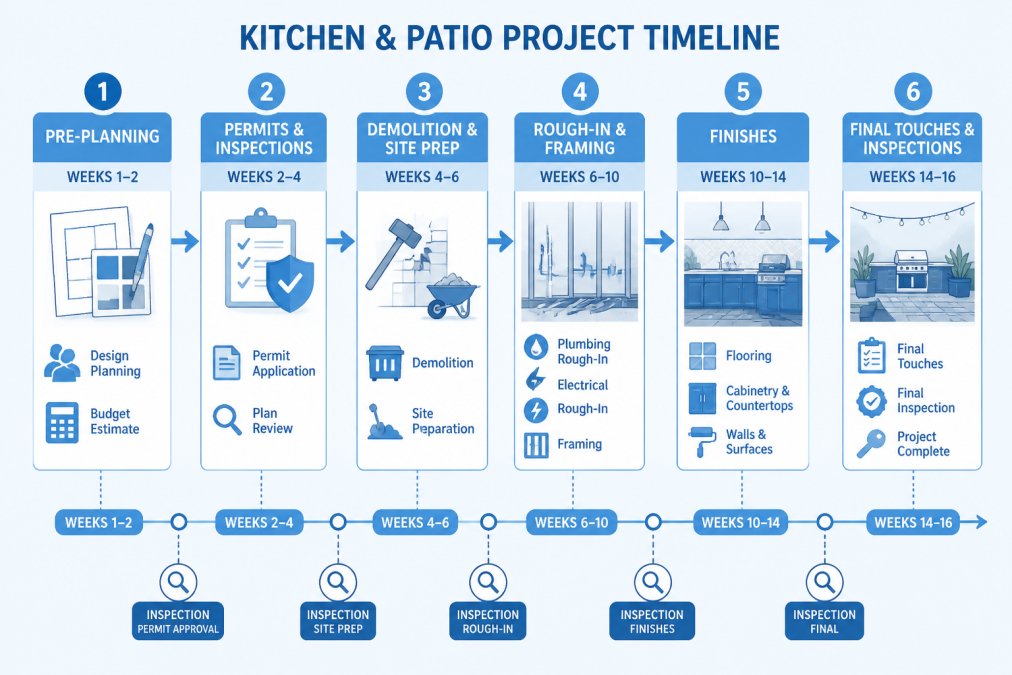
Weather can add several weeks in winter. Permit delays can add several weeks. Material shortages can delay appliance or cabinetry arrival. A good contractor builds contingency into the timeline and communicates delays proactively.
Ask your contractor for a detailed project schedule showing each phase, key milestones, and inspection dates. Update it weekly. If you're more than one week behind schedule without a clear reason, ask why and what the plan is to catch up.
Permits, Building Codes, and Compliance
Kitchen and patio work requires permits. Unpermitted work can affect your home's resale value, void your homeowner's insurance, and create liability if someone is injured.
Your contractor should handle permit applications. If they say "permits are optional" or "we can do this without a permit," walk away.
Building codes specify how electrical systems must be installed (outlet spacing, wire gauge, circuit capacity), how plumbing must be installed (pipe sizing, slope, venting), and how structures must be built (foundation depth, framing standards, load capacity). These are based on decades of engineering and failure analysis.
A kitchen renovation triggers electrical and plumbing permits. A patio triggers permits because the foundation must be engineered for your soil conditions and climate. An outdoor kitchen or fire pit triggers electrical and gas permits.
The permit process:
- Contractor submits plans to your local building department
- Building department reviews for code compliance (typically a few weeks)
- If approved, you receive a permit and can start work
- During construction, inspectors verify work meets code (rough-in inspection, final inspection)
- Once all inspections pass, you receive a certificate of completion
Ask your contractor:
- "What permits does this project require?"
- "Who's responsible for submitting permit applications?"
- "What's the estimated permit approval timeline?"
- "How many inspections will we need?"
- "What happens if the inspector finds a code violation?"
A contractor who knows the permit process and has relationships with local inspectors moves faster.
Coordinating Indoor-Outdoor Integration and Contractor Accountability
The hardest part of a kitchen and patio project is making them work together. The kitchen must have utilities extending outdoors (electrical for an outdoor kitchen, gas for a grill, water for a sink). The patio must drain water away from the house and protect utilities properly.
This requires coordination between kitchen and patio work. Without communication, you end up with problems: electrical conduit running through the patio foundation, or a patio grade sloping toward the house instead of away from it, or utility lines that aren't properly buried.
A general contractor manages this. They ensure kitchen utility extensions are planned before the patio foundation is dug. They verify the patio grade slopes correctly and outdoor electrical and gas connections are installed to code.
If you're using separate contractors, manage this coordination yourself. Get written confirmation from both that they've reviewed each other's plans and understand the dependencies. Have them sign off on utility locations and patio grading before work starts.
Something will go wrong. When it does, you need to know whose responsibility it is to fix it.
A general contractor is accountable for everything. If the electrician doesn't show up, that's the contractor's problem. If the patio foundation cracks because of poor site prep, that's the contractor's responsibility to fix.
With separate subcontractors, accountability is murky. Get everything in writing. When the contractor inspects the site, have them document existing conditions with photos. When they complete their phase, have them document what they've done and what the next phase depends on. This creates a paper trail protecting you if disputes arise.
Ask your contractor how they handle disputes between trades. A good answer is "I make the call based on code and the project plan, and both trades follow it." A bad answer is "we work it out as we go."
Hiring a contractor for kitchen and patio work is the most important decision in your renovation. The wrong choice derails your timeline, blows your budget, and leaves you with quality issues. The right choice delivers on time, within budget, and coordinates indoor and outdoor work seamlessly.
Start by getting three detailed estimates from contractors with kitchen and patio experience. Verify their licensing and insurance. Call their references. Ask the hard questions about timeline, payment, warranty, and change orders. Review the scope of work and contract carefully before you sign.
Fluent Contracting brings over 20 years of construction and hardscaping experience to kitchen and patio projects. We handle the coordination between your indoor renovation and outdoor living space, manage permits and inspections, and deliver on schedule with transparent pricing and flexible financing options. If you're ready to move forward, Get Started with a free project consultation.
Frequently Asked Questions
What are the biggest red flags when hiring a contractor for kitchen and patio work?
Watch for contractors who avoid written contracts, can't provide references or recent project photos, quote significantly lower than others without explanation, pressure you to pay large upfront deposits, or lack proof of licensing and insurance. Contractors who won't discuss timelines, change order procedures, or warranty terms are also warning signs. Trust your instinct if communication feels evasive or unprofessional.
Should I hire one general contractor for both kitchen and patio projects, or separate contractors?
A single general contractor who handles both construction and hardscaping eliminates coordination headaches and creates accountability for the entire project. They manage subcontractors, ensure timelines align, and take responsibility for how indoor and outdoor work integrate. However, verify they have genuine expertise in both trades, some contractors subcontract one side and lose quality control. Ask for portfolio examples of completed integrated projects.
How do I verify a contractor's license and insurance?
Request their contractor license number and verify it with your state's licensing board or construction regulatory agency. Ask for proof of general liability insurance and worker's compensation coverage, and contact their insurance provider directly to confirm active policies. Don't accept verbal assurances, always request official documentation. Licensed and insured contractors protect you from liability if someone is injured or property is damaged during work.
What questions should I ask a general contractor before hiring?
Ask about their experience with kitchen and outdoor projects, timeline estimates, how they handle change orders and unexpected issues, warranty coverage, payment schedule structure, and their process for managing permits and inspections. Request references from recent clients and ask about their approach to site cleanup and communication during the project. Clarify who handles what work and whether they subcontract, and ask how they manage contractor conflicts if issues arise.
This article was written using GrandRanker