
 ultimate-guide
Best Financing Options for Home Remodeling in 2026
Table of Contents
- Quick Comparison: Home Equity Loans vs. HELOCs vs. Personal Loans
- HELOC vs Home Equity Loan for Renovations: Which Fits Your Project?
- Cash-Out Refinancing and Construction Loans for Major Additions
- Home Improvement Loan Requirements: What Lenders Check
- Government-Backed Loans and Energy-Efficient Upgrade Financing
- Budgeting for Luxury Home Renovations Without Overextending
- Tax Implications and ROI: What Most Homeowners Miss
- Frequently Asked Questions
Financing Options for Home Remodeling: The 2026 Landscape
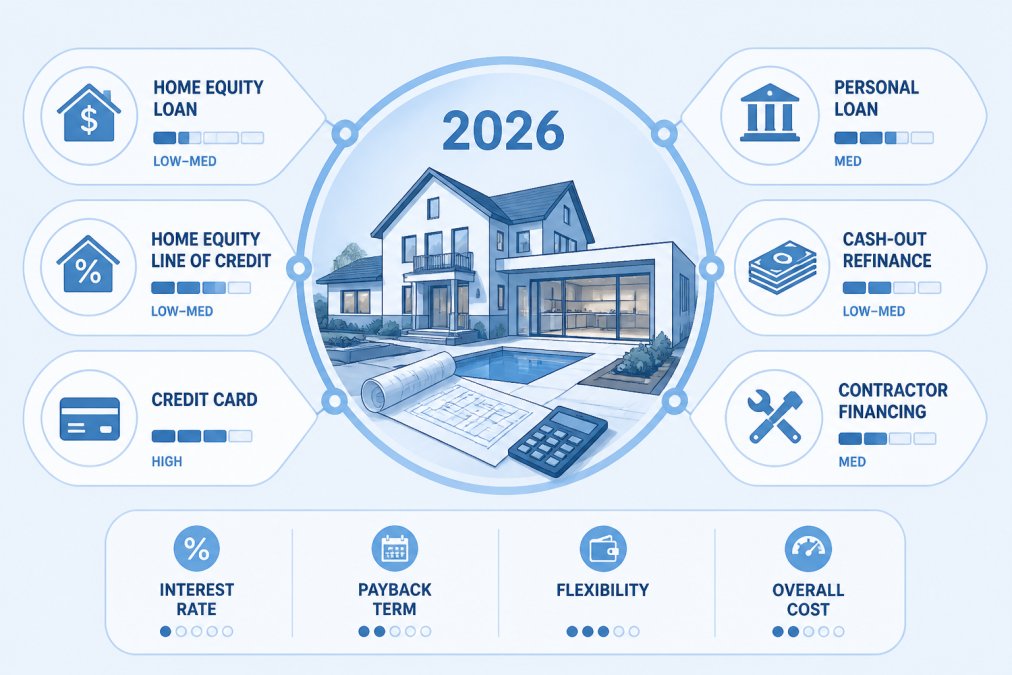
Choosing the right financing options for home remodeling often matters more than the design choices themselves, since the cost of borrowing can add thousands to your total project budget. The real decision hinges on your equity stake, your timeline, and whether the project is a planned upgrade or an emergency repair.
Choosing the right financing options for home remodeling often matters more than the design choices themselves, since the cost of borrowing can add thousands to your total project budget. The real decision hinges on your equity stake, your timeline, and whether the project is a planned upgrade or an emergency repair. The most common error homeowners make is choosing a financing vehicle before getting a realistic renovation budget from a contractor, which leads to over-borrowing or stalling mid-project.
Quick Comparison: Home Equity Loans vs. HELOCs vs. Personal Loans
The three most common financing options are home equity loans, HELOCs, and unsecured personal loans, and each serves a different project profile. A home equity loan provides a lump sum at a fixed rate with predictable payments, ideal for projects with a clear, upfront scope. A HELOC offers a variable-rate line of credit you draw from as work progresses, suiting phased renovations. Personal loans require no collateral but carry higher APRs, making them best for smaller updates where speed matters more than total interest cost.
| Financing Option | Typical APR Range | Repayment Terms | Funding Speed | Best For |
|---|---|---|---|---|
| Home Equity Loan | Lower fixed rates | 5-15 years | 2-6 weeks | Large, defined projects |
| HELOC | Variable rates | 10-year draw, 20-year repayment | 2-4 weeks | Phased or ongoing work |
| Personal Loan | Higher fixed rates | 2-7 years | 1-7 days | Small updates, urgent needs |
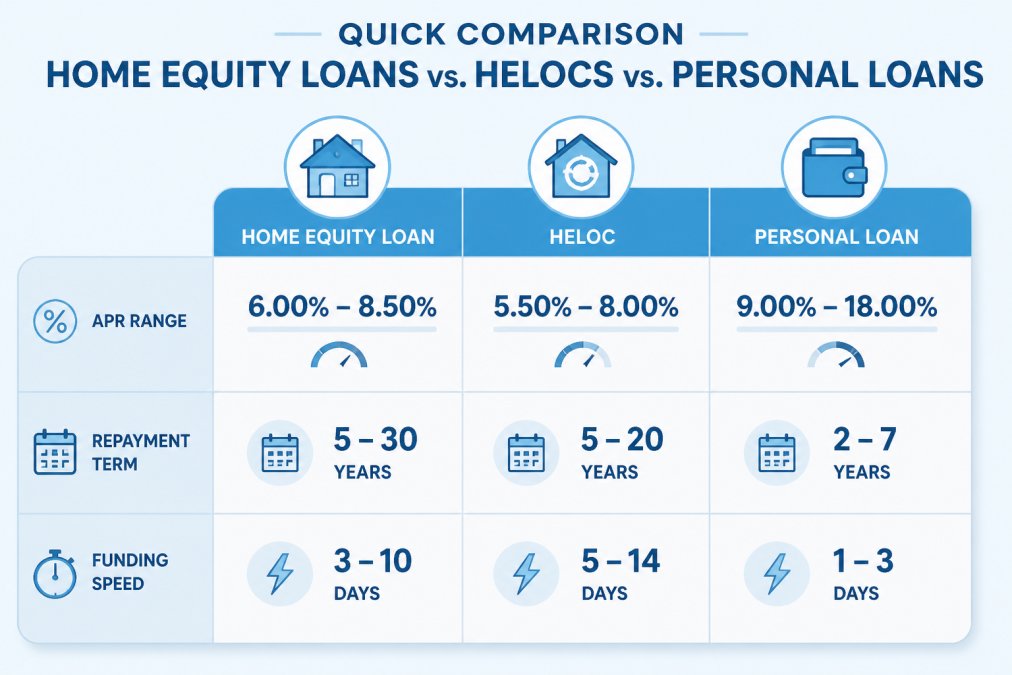
The funding speed difference matters more than most homeowners expect. If your water heater fails or a roof starts leaking, waiting six weeks for a home equity loan approval while water damages your floors is not a viable strategy. For emergency repairs, the faster approval of a personal loan often justifies the higher interest rate.
HELOC vs Home Equity Loan for Renovations: Which Fits Your Project?
The HELOC vs home equity loan decision comes down to one question: do you know exactly what your project will cost? Home equity loans shine when you have a fixed bid and a defined scope, because you borrow once, lock your rate, and make consistent monthly payments.
HELOCs make more sense for phased projects or when you want flexibility in how much you draw. A common pattern is funding a bathroom renovation now and a patio installation next year, drawing only what you need at each stage. The trade-off is rate volatility, since your monthly payments can rise if interest rates climb.
| Scenario | Home Equity Loan Behavior | HELOC Behavior | Better Choice |
|---|---|---|---|
| Fixed bid, single-phase project (e.g., kitchen remodel) | Lump sum covers the bid; fixed rate locks in predictable payments | You draw gradually, but you pay variable rates on the outstanding balance | Home Equity Loan |
| Phased project over 12-24 months (e.g., basement finish, then landscaping) | You pay interest on the full lump sum from day one, even before work begins | You only pay interest on what you draw, when you draw it | HELOC |
| Project with high uncertainty (e.g., structural repair where hidden damage is likely) | You must reapply or take a second loan if costs exceed the original bid | You can draw additional funds up to your credit limit without reapplying | HELOC |
| You expect interest rates to rise over the next 2-3 years | Fixed rate protects you from payment increases | Variable rate means your monthly interest charges will climb | Home Equity Loan |
| You plan to pay off the debt in under 3 years | Closing costs and origination fees spread over a short period raise your effective APR | Many HELOCs have no closing costs, making short-term borrowing cheaper | HELOC |
The two products also differ in how they handle a stalled project. With a home equity loan, you receive the full amount at closing, so if your contractor abandons the project or you scale back the scope, you still make payments on money you did not spend. A HELOC lets you leave undrawn funds untouched, avoiding interest on money you never used, making it structurally safer when the final scope is not locked down.
Your credit score and debt-to-income ratio determine whether either option is available to you. Lenders typically want to see a loan-to-value ratio at or below 80%, meaning you need at least 20% equity remaining after the loan. If your equity stake is thin, a personal loan or government-backed option may be your only path.
The cost structure at closing also separates the two products. Home equity loans typically carry origination, appraisal, and title search fees totaling 2% to 5% of the loan amount. Many HELOCs are marketed as no-closing-cost products, though you may pay an annual fee and a termination fee if you close the line early. For a $50,000 project, those upfront differences can amount to $1,000 or more, directly affecting your effective interest rate.
Repayment mechanics also affect monthly cash flow. A home equity loan amortizes immediately, so your first payment includes principal and interest. A HELOC typically has an interest-only draw period lasting 10 years, during which your minimum payment covers only interest, meaning you are not building equity, and you will face a significant payment jump when the repayment period begins.
Many financial planners recommend a "two-account strategy" for projects combining known and unknown elements: fund the contractor's fixed bid with a home equity loan, then open a smaller HELOC as a contingency reserve for surprises during demolition or inspection. This locks in a low fixed rate on most of your borrowing while giving flexible access to emergency funds.
Finally, consider how each product affects future refinancing of your primary mortgage. Both a home equity loan and a HELOC are second mortgages, so the second lien holder must agree to subordinate their position if you refinance your first mortgage, which can delay or complicate the process. Consolidating both into a cash-out refinance resets your primary mortgage term and may not be worth the closing costs.
Cash-Out Refinancing and Construction Loans for Major Additions
For substantial projects like home additions or whole-home remodels, cash-out refinancing and construction loans offer access to larger sums. Cash-out refinancing replaces your existing mortgage with a new, larger loan and you receive the difference as cash. It can secure a lower rate than a home equity loan if mortgage rates are favorable, but it resets your loan term and carries significant closing costs.
Construction loans are short-term, variable-rate loans that pay contractors in draws as work reaches milestones. They require a home appraisal and detailed project plans, and typically convert to a permanent mortgage once construction finishes. They work well for new builds or major additions, but the application process is more involved and lender requirements are stricter.
A less common but valuable option is the renovation mortgage, which rolls the cost of your purchase and renovation into a single loan. Products like the FHA 203(k) loan allow you to finance both the home purchase and the remodeling costs together, which can be ideal for buyers targeting fixer-uppers.
Home Improvement Loan Requirements: What Lenders Check
Home improvement loan requirements vary by product, but lenders evaluate a consistent set of factors. Your credit score is the starting point, a FICO score above 700 generally qualifies for the most favorable terms, while scores below 620 may limit you to personal loans or government-backed programs.
The second major factor is your debt-to-income ratio, which most conventional lenders cap at 43%, though some programs allow up to 50% with compensating factors. For secured loans, lenders also require a professional home appraisal to confirm your property's value and calculate your available equity.
Documentation includes proof of income, tax returns, bank statements, and details about your renovation plans. Detailed, itemized contractor bids make this process smoother, since lenders want to verify the loan amount aligns with the project scope.
Government-Backed Loans and Energy-Efficient Upgrade Financing
Government-backed improvement loans expand access to financing for homeowners who may not qualify for conventional products, and they offer specific advantages for energy-efficient upgrades. The FHA 203(k) program, insured by the Federal Housing Administration, allows borrowers to finance both home purchase and renovation costs in a single mortgage, with down payments as low as 3.5% of the total loan amount. The U.S. Department of Housing and Urban Development's 203(k) program guide explains the two variants: the limited version for projects under a certain threshold and the standard version for major structural work.
For energy-efficient improvements, the ENERGY STAR program and state-level initiatives provide financing for upgrades like new HVAC systems, insulation, and solar panels. Many utility companies also offer on-bill financing, where improvement costs are repaid through your monthly utility bill, often with no upfront payment.
Budgeting for Luxury Home Renovations Without Overextending
Budgeting for luxury home renovations requires different discipline than standard remodeling, because scope can expand quickly. The starting point is a realistic budget that includes a contingency of at least 10-20% of the total project cost for unexpected findings behind walls, under floors, or in aging electrical systems.
Most budgeting guides stop at the contingency fund, missing the distinction between emergency repairs and planned renovations. A roof failure does not wait for you to compare loan products; a planned kitchen remodel does. Your budgeting approach must reflect which category your project falls into, because the cost of waiting differs dramatically.
For emergency repairs, the priority is speed and cash-flow preservation, not interest-rate optimization. When your water heater fails and floods your basement, waiting two weeks for a home equity loan approval means ongoing water damage and potential mold remediation. A personal loan funded within days, even at a higher APR, often costs less than the additional damage incurred during a longer approval process. Borrow the minimum needed to restore function and pay it off aggressively.
For planned luxury renovations, the most common mistake is securing financing based on a contractor's initial estimate, then expanding scope mid-project without revisiting borrowing capacity. An $80,000 kitchen renovation becomes a $110,000 project when the homeowner upgrades from quartz to marble, adds a custom vent hood, and refinishes adjacent hardwood floors. Each upgrade seems reasonable in isolation, but collectively they push past your debt-to-income comfort zone.
A more rigorous approach is the "project-tier" budgeting method. Before you borrow, divide your renovation into three tiers:
- Tier 1, Non-negotiable: Structural work, electrical and plumbing updates, permits, and code compliance. These costs are fixed and must be fully funded.
- Tier 2, High-value finishes: Materials and fixtures that affect daily use and resale value, such as cabinetry, countertops, and appliances. These should be funded up to a pre-set ceiling.
- Tier 3, Discretionary enhancements: Decorative elements, premium appliance upgrades, smart-home features, and aesthetic choices that do not affect function or resale. These are funded only if Tier 1 and Tier 2 come in under budget.
This tiering forces you to make trade-offs before you borrow, rather than discovering mid-project that you cannot afford the choices you have already made. It also gives your contractor a clear decision framework when you are tempted by an upgrade during the build.
Most budgeting advice also fails to account for the opportunity cost of your renovation capital. When you borrow $100,000 at 8% for a kitchen remodel, you are not just paying $8,000 per year in interest, you are forgoing whatever that $100,000 could have earned elsewhere. If your retirement accounts average 7-10% annual returns, the true cost includes both the loan interest and the investment returns you miss.
The "renovation-to-equity" ratio is another useful guardrail. Most lenders allow borrowing up to 80% of your home's value across all mortgages; a prudent rule is to keep total borrowing at or below 70% after the renovation. This buffer protects you from being underwater if property values decline and preserves equity access for genuine emergencies.
Consider the appraisal impact before you borrow. A $150,000 kitchen and primary suite renovation in a neighborhood where comparable homes sell for $600,000 may only increase your home's value by $80,000 to $100,000, creating debt not backed by increased value. This is acceptable if you plan to stay 10 or more years and the renovation improves daily life, but a poor decision if you plan to sell within five years.
Finally, match your loan term to the useful life of the improvement, not the lowest monthly payment. A roof or HVAC system lasting 20 years can justify a longer term, while a cosmetic kitchen update should be paid off faster than the cabinets will last. Extending a $50,000 kitchen remodel to 15 years means you will still be paying when the countertops are dated, the lower payment is an illusion of affordability that costs thousands in total interest.
Tax Implications and ROI: What Most Homeowners Miss
The tax treatment of your financing choice and the return on investment of your renovation are two factors that most homeowners overlook when comparing financing options for home remodeling. Interest on home equity loans and HELOCs is tax-deductible only if the funds are used to substantially improve the home, and only up to certain limits. The IRS guidelines on home equity loan interest deductibility clarify that the deduction applies when the loan is secured by your home and the proceeds fund capital improvements.
Personal loan interest is never tax-deductible, regardless of how you use the funds. This distinction can make a secured home equity loan more attractive than a personal loan for larger projects, even when the interest rates are similar, because the after-tax cost of borrowing is lower.
Return on investment varies dramatically by project type. Kitchen renovations and bathroom updates typically recoup a higher percentage of their cost at resale than luxury additions or high-end finishes. Before financing a major project, research which improvements add the most home value appreciation in your market, and be honest about whether you are renovating for your own enjoyment or for future resale value. The Remodeling Magazine's annual Cost vs. Value Report tracks these returns across markets and project types, and it is worth consulting before you commit to a financing structure.
Funding a home remodel is a balancing act between your vision, your budget, and your long-term financial health. The right financing option aligns with your project scope, your timeline, and your ability to manage monthly payments without strain. At Fluent Contracting, we help homeowners across Atlanta and Savannah navigate this process with detailed project bids, transparent timelines, and access to flexible financing options with fast approval. Get started with Fluent Contracting and turn your remodeling vision into a well-funded reality.
Frequently Asked Questions
What is the best way to finance a home remodel?
The best method depends on your equity position, credit score, and project size. Home equity loans and HELOCs typically offer lower APRs than personal loans because they are secured by your property. If you have at least 15-20% equity and a credit score above 680, a home equity product usually wins. For smaller projects under $25,000, an unsecured personal loan may make more sense despite higher rates, since you avoid closing costs and appraisal fees.
What is the 30% rule for home renovation budgeting?
The 30% rule suggests you should not spend more than 30% of your home's current value on a single renovation project. This guideline protects your resale value: overspending beyond this threshold typically yields a lower return on investment. Certain upgrades like kitchen remodels and primary bathroom updates tend to recoup a higher percentage of costs, while luxury pools and high-end finishes often return far less.
How much remodeling can be done with $100,000?
The scope of a renovation depends heavily on your region's labor rates and material costs. In higher-cost areas, a significant budget typically covers one major space; in lower-cost regions, it may stretch to two rooms or a smaller addition.
What are the home improvement loan requirements for a HELOC?
Lenders typically require at least 15-20% equity in your home, meaning your loan-to-value ratio stays at or below 80-85%. You will need a credit score of 680 or higher for competitive rates, though some lenders accept 620 with higher APRs. Your debt-to-income ratio should be below 43%. Expect to provide two years of tax returns, recent pay stubs, and a home appraisal. Approval usually takes 2-6 weeks, slower than personal loans but faster than construction loans.
Do I have to put 20% down on a construction loan?
Not always, but 20% down is common for construction loans because they carry higher risk for lenders. Some lenders accept 10-15% down if you have excellent credit and the land is already paid for. Construction loans differ from traditional mortgages: they disburse funds in stages as work completes, and you pay interest only on the drawn amount. After construction finishes, the loan typically converts to a permanent mortgage, which may require a new appraisal and credit check.
How do home improvement loans differ from personal loans?
Home improvement loans are often secured by your property's equity, either as a home equity loan or HELOC, which produces lower APRs but puts your home at risk if you default. Personal loans are unsecured, meaning no collateral is required, but rates run 3-6 percentage points higher. Home equity loans provide lump sums with fixed rates, while personal loans offer flexible amounts from $1,000 to $100,000. Approval for personal loans is faster, often within days versus weeks for equity products.
Can I finance energy-efficient upgrades separately?
Yes. The Federal Housing Administration's Energy Efficient Mortgage program lets you finance improvements like solar panels, HVAC upgrades, and insulation into an FHA loan. The Department of Energy also supports Property Assessed Clean Energy (PACE) financing in many states, which attaches repayment to your property tax bill. These options often require no upfront payment and may offer longer terms than traditional loans. Some states and utilities add rebates or tax credits that reduce net costs substantially.